
Keys: Space play/pause · ←/→ 10s · F fullscreen · M mute · </> speed
Plot
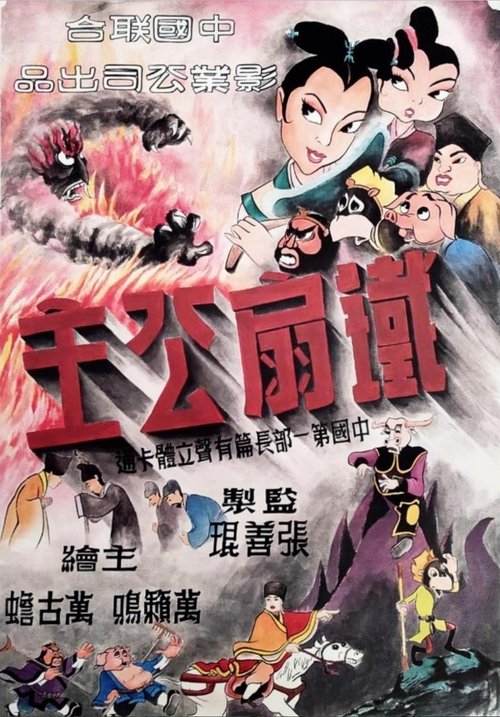
The story follows the monk Xuanzang and his three disciples—Sun Wukong (the Monkey King), Zhu Bajie (Pigsy), and Sha Wujing (Sandy)—as they encounter the insurmountable Flaming Mountains during their pilgrimage to the West. To quench the magical fires blocking their path, Sun Wukong must obtain the legendary Banana Leaf Fan from the vengeful Princess Iron Fan, who harbors a deep grudge against him. The narrative unfolds through a series of shapeshifting duels and comedic deceptions as Wukong attempts to steal the fan, leading to a climactic battle involving the Princess's husband, the Bull Demon King. Ultimately, the film emphasizes the necessity of collective action, as the local peasantry joins forces with the protagonists to defeat the demons and clear the path to enlightenment.
About the Production
Release Date November 19, 1941
Budget Approximately 50,000 yuan (estimated)
Box Office Highly successful in China and Japan; specific figures are unrecorded due to wartime conditions.
Production Xinhua Film Company, United China Film Company
Filmed In Shanghai, China
Produced during the Japanese occupation of Shanghai, the film took three years to complete with a team of over 200 artists. The Wan brothers faced severe shortages of materials like celluloid and ink, often having to improvise with local substitutes. The animation was heavily influenced by the rotoscoping technique used by the Fleischer Studios, though adapted for a traditional Chinese aesthetic. Despite the 'Solitary Island' period of Shanghai's history, the production was a massive logistical undertaking that required the brothers to work under constant surveillance and economic pressure.
More Fantasy Films
View all →
Themes & Topics
Monkey KingJourney to the WestMagic FanFlaming MountainsShapeshiftingDemonsBuddhismFolkloreAllegoryBattle
Historical Background
The film was produced during the Second Sino-Japanese War, specifically during the period when Shanghai was partially occupied. The 'Solitary Island' period allowed for some creative freedom in the foreign concessions, but the atmosphere was one of extreme tension and scarcity. The film's production served as a morale booster for the Chinese public. Its release occurred just weeks before the attack on Pearl Harbor, which led to the full Japanese occupation of Shanghai's international zones. The film's subtext of a unified front against a powerful demon was a clear call for national unity against the Japanese military, making it a significant piece of wartime propaganda disguised as a folk tale.
Why This Film Matters
Princess Iron Fan is the cornerstone of Asian animation history. It established the 'Shanghai School' of animation, which blended traditional Chinese art forms—such as ink-wash painting and shadow puppetry—with Western cinematic techniques. Its success in Japan directly influenced the development of the anime industry, specifically inspiring Osamu Tezuka to create 'Alakazam the Great' and 'Astro Boy.' It remains a symbol of Chinese cultural resilience and artistic innovation during one of the country's darkest historical periods.
Making Of
The Wan brothers were inspired to create a feature-length film after seeing Disney's 'Snow White and the Seven Dwarfs' when it screened in Shanghai in 1938. They wanted to prove that China could produce a work of equal technical merit and cultural depth. Working in the 'Solitary Island' (the International Settlement of Shanghai), they faced immense technical hurdles, including a lack of specialized animation cameras. They built their own multiplane camera setups using wood and scrap metal. The production was nearly shut down several times due to the rising costs of materials during the Japanese occupation, but funding from the Xinhua Film Company allowed them to finish. The brothers intentionally infused the film with the spirit of the 'War of Resistance,' using the Monkey King's struggle as a metaphor for the Chinese people's fight.
What Critics Said
At the time of its release, it was hailed as a technical marvel and a triumph for the Chinese film industry. Critics praised its ability to adapt a classic literary work into a modern medium. Modern critics view it as a fascinating hybrid of Disney-esque fluidity and traditional Chinese opera aesthetics. While some modern viewers find the rotoscoping slightly uncanny or the pacing slow compared to contemporary animation, it is universally respected by film historians for its ambition and historical importance.
Did You Know?
- It is the first feature-length animated film produced in China and the first in Asia.
- The film was created by the Wan brothers (Wan Laiming, Wan Guchan, Wan Chaochen, and Wan Dihuan), who are considered the pioneers of Chinese animation.
- Osamu Tezuka, the 'God of Manga,' cited this film as his primary inspiration for pursuing a career in animation after seeing it as a teenager in Japan.
- The film uses rotoscoping for many character movements, which involved filming live actors and then tracing over the frames.
- The character of the Monkey King was designed to look somewhat like Mickey Mouse to appeal to international sensibilities while maintaining Chinese characteristics.
- Due to the wartime shortage of film stock, the brothers often had to wash and reuse old film to create new animation cells.
- The film was released in Japan in 1942 under the title 'Tetsurin Senjo' and was a surprise hit despite the ongoing war.
- The voice acting was provided by famous Shanghai movie stars of the era, including Bai Hong and Jiang Ming.
- The film's message of 'unity against a common foe' was a thinly veiled allegory for Chinese resistance against Japanese invasion.
- It took over 20,000 drawings and 350,000 pieces of paper to complete the production.
Awards & Recognition
- Recognized as a 'Masterpiece of Early Animation' by the China Film Archive
- Special Commemoration at the 1982 Cambridge Animation Festival
More film details Visual style, music, quotes, restoration, and more
Visual Style
The film utilizes a mix of hand-drawn backgrounds that resemble traditional Chinese landscape paintings and rotoscoped character animation. The use of shadows and silhouettes is particularly notable, drawing from the tradition of Chinese shadow play. The Wan brothers experimented with depth by using layered glass plates to create a primitive multiplane effect, giving the Flaming Mountains a sense of scale and menace. The visual style is characterized by high contrast and expressive, often exaggerated, character movements.
Innovations
It was the first film in Asia to successfully utilize feature-length rotoscoping. The Wan brothers developed a unique method of synchronizing sound and animation under primitive conditions. They also pioneered the use of 'special effects' in animation, such as the depiction of smoke, fire, and magical transformations, which were achieved through painstaking frame-by-frame manipulation of light and ink.
Music
The film features a rich score that blends traditional Chinese instruments (such as the erhu and pipa) with Western orchestral arrangements. The music is used to punctuate the action sequences and provide a rhythmic foundation for the comedic 'mickey-mousing' effects. The songs performed by the characters are reminiscent of the popular 'Shidaiqu' music of 1940s Shanghai, featuring high-pitched, operatic vocal styles that were popular at the time.
Famous Quotes
Sun Wukong: 'Without the fan, the fire will never die, and the people will never know peace.'
Princess Iron Fan: 'You may have the strength of a god, but you will never have my fan!'
Villager: 'When we all pull together, even the mountains must move.'
Zhu Bajie: 'Master, my belly is empty, but the road is full of fire!'
Memorable Scenes
- The sequence where Sun Wukong transforms into a fly to enter the Princess's tea cup and eventually her stomach.
- The climactic battle where the Bull Demon King transforms into a giant white bull to fight the protagonists.
- The visually striking opening sequence showing the intense heat of the Flaming Mountains distorting the air.
- The scene where the Monkey King and the Princess engage in a rapid-fire shapeshifting duel, turning into various animals to outsmart one another.
What Audiences Thought
The film was an enormous hit with audiences in Shanghai and later in Japan. In China, viewers immediately resonated with the allegorical message of the Monkey King leading the peasants to victory. In Japan, despite being 'enemy' cinema, it was so popular that it reportedly influenced the Japanese Navy to fund their own feature-length animation, 'Momotaro's Divine Sea Warriors.' Today, it is viewed with nostalgia and pride by Chinese audiences as the ancestor of all domestic animation.
Film Connections
Influenced By
- Disney's Snow White and the Seven Dwarfs (1937)
- Fleischer Studios' Popeye and Betty Boop
- Traditional Chinese Shadow Puppetry
- The classic novel 'Journey to the West' by Wu Cheng'en
This Film Influenced
- Momotaro's Divine Sea Warriors (1945)
- Alakazam the Great (1960)
- Havoc in Heaven (1961)
- The works of Osamu Tezuka
- Dragon Ball (thematic influence)
Film Restoration
The film has been preserved and restored by the China Film Archive. While some original elements were damaged due to the age of the nitrate stock, digital restorations have been performed to stabilize the image and clean the soundtrack for modern audiences.
Where to Watch
- YouTube (Public Domain)
- The China Film Archive
- Various classic cinema streaming platforms
- Bilibili (with subtitles)