
Keys: Space play/pause · ←/→ 10s · F fullscreen · M mute · </> speed
Plot
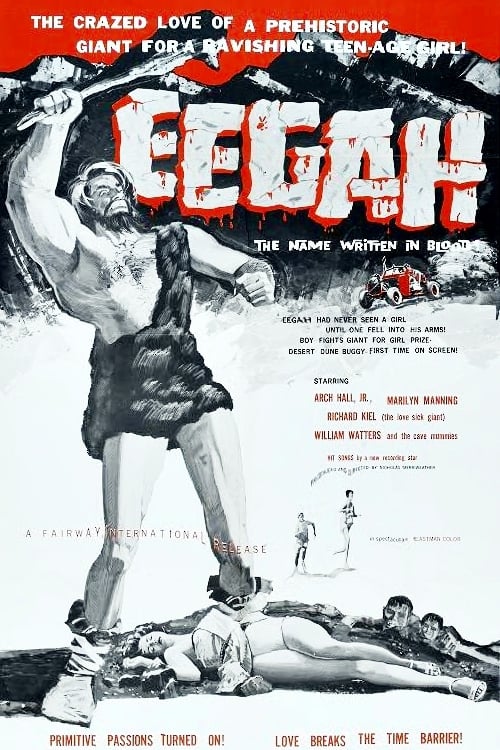
Teenager Roxy Miller encounters a giant caveman named Eegah while driving through the California desert. She tells her boyfriend Tom Nelson and her father Robert, who is an amateur archaeologist, about the discovery. Robert decides to investigate and is captured by Eegah, who lives in a cave with his mummified family. Tom and Roxy venture into the desert to rescue Robert, leading to a series of dangerous encounters with the prehistoric giant. Eegah becomes infatuated with Roxy and follows them back to civilization, causing chaos at a pool party. The film culminates in a violent confrontation where Eegah is ultimately killed, but not before leaving a lasting impression on everyone involved.
About the Production
Release Date November 1962
Budget $50,000
Box Office Unknown (limited release)
Production Fairway International Pictures, Arch Hall Sr. Productions
Filmed In Palmdale, California, Lancaster, California, Mojave Desert
The film was shot in just two weeks with a minimal crew. Richard Kiel, who played Eegah, had to endure hours of makeup application each day and wore platform shoes to appear taller. The cave scenes were filmed at Vasquez Rocks Natural Area Park. The infamous shaving cream scene was improvised on set when the production ran out of prop blood.
Themes & Topics
Historical Background
Eegah was produced during the early 1960s drive-in movie boom, when low-budget horror and science fiction films were in high demand. The Cold War era fascination with prehistoric threats and atomic mutations influenced many films of this period. The movie reflects the teenage culture of the early 1960s, with its focus on young protagonists, rock and roll music, and hot rod cars. It was also made during the transition from the studio system to independent filmmaking, allowing small production companies to create content for the expanding drive-in theater market.
Why This Film Matters
Despite its poor quality, Eegah has achieved significant cult status over the decades. Its appearance on Mystery Science Theater 3000 in 1993 introduced it to a new generation of bad movie enthusiasts. The film is often cited as one of the worst movies ever made, appearing on many 'worst films' lists. Richard Kiel's performance as Eegah, despite the film's flaws, helped launch his career, leading to his iconic role as Jaws in the James Bond series. The movie has become a touchstone for B-movie appreciation and is frequently screened at 'bad movie' festivals and midnight shows.
Making Of
The production was a family affair, with Arch Hall Sr. directing, his wife producing, and their son starring. The film was made quickly and cheaply, typical of the drive-in movie era. Richard Kiel was discovered by the Hall family while working as a bouncer. The desert location filming was challenging due to extreme temperatures, with cast members suffering from heat exhaustion. The infamous scene where Eegah shaves with a rock was considered too graphic by some theaters and was cut in certain markets. The film's soundtrack was recorded separately, with Arch Hall Jr.'s musical performances added to showcase his singing talent.
What Critics Said
Contemporary reviews were overwhelmingly negative, with critics mocking the film's poor production values, terrible acting, and nonsensical plot. The Los Angeles Times called it 'an embarrassment to cinema' while Variety noted its 'complete lack of artistic merit.' Modern critics have been kinder in a way, recognizing the film's entertainment value as a 'so bad it's good' classic. Roger Ebert included it in his list of 'Most Hated' films, while the Golden Turkey Awards named it one of the worst films of all time.
Did You Know?
- Richard Kiel, who played Eegah, was 7'2" tall but still had to wear platform shoes to appear even more imposing
- The film was featured on Mystery Science Theater 3000, which helped cement its cult status
- Arch Hall Jr. sings three songs in the film, including 'Valerie' which was released as a single
- The title character's name was originally going to be 'Eegah the Stone Age Killer'
- The film's budget was so low that the crew used real animal bones from a butcher shop for the caveman's cave
- Director Arch Hall Sr. cast his son Arch Hall Jr. as the lead to launch his music career
- The famous line 'Watch out for snakes!' became an internet meme decades after the film's release
- The film was shot without sound recording and all dialogue was dubbed later
- Richard Kiel's makeup was so thick that he could barely eat or drink during filming
- The movie was part of a double feature with 'The Choppers' in many theaters
More film details Visual style, music, quotes, restoration, and more
Visual Style
The cinematography by William M. Wages was rudimentary but effective for a low-budget production. The desert locations were captured with stark, high-contrast lighting that emphasized the harsh environment. Many shots were handheld due to budget constraints, giving the film a documentary-like feel in outdoor scenes. The cave sequences used dramatic shadows and low-key lighting to create atmosphere, though the effect was often undermined by poor lighting equipment. The film occasionally employed Dutch angles during action scenes to suggest chaos and danger.
Innovations
Eegah employed minimal technical innovation but did feature some interesting makeup effects for its time. Richard Kiel's caveman makeup, created by a team led by Jack Young, involved extensive prosthetics and hair work that took hours to apply each day. The film used process photography for some driving scenes, a common technique in low-budget productions. The sound recording was done entirely in post-production, a cost-saving measure that resulted in poorly synchronized dialogue.
Music
The film's music was composed by Arch Hall Sr. under the pseudonym William Watters. The soundtrack prominently features rock and roll songs performed by Arch Hall Jr., including 'Valerie,' 'I Live for Love,' and 'Dawn of Love.' These musical interludes were clearly designed to promote Hall Jr.'s singing career rather than serve the narrative. The incidental music was minimal, consisting mainly of stock library cues and simple percussion elements. The sound quality was poor due to the film's post-production dubbing process.
Famous Quotes
Eegah!" - Roxy Miller upon first seeing the caveman
Watch out for snakes!" - Robert Miller's repeated warning
Daddy, I saw him! He was huge!" - Roxy describing Eegah
Stupid teenagers!" - Eegah's thoughts (implied through grunts)
You're the first girl I've ever seen!" - Eegah's fascination with Roxy" ]
memorableScenes
preservationStatus
The film exists in its complete form and has been preserved through various home video releases. The original negative status is unknown, but multiple 35mm prints have survived. The film entered the public domain, which has led to numerous poor quality DVD releases. A restored version was released by the Film Detective in 2017, sourced from the best available elements.
whereToWatch
What Audiences Thought
Initial audience response was poor, with the film performing badly at the box office during its limited theatrical run. However, over the decades, it has developed a devoted cult following. Drive-in audiences in the 1960s reportedly laughed at the film's absurdity. Modern audiences often seek it out specifically for its camp value and unintentional humor. The film's MST3K appearance created a new fan base that appreciates it as a piece of bad movie history.
Film Connections
Influenced By
- King Kong (1933)
- The Beast from 20,000 Fathoms (1953)
- Teenage monster movies of the 1950s
This Film Influenced
- The Lost Continent (1968)
- The Mighty Gorga (1969)
- various MST3K-featured films